

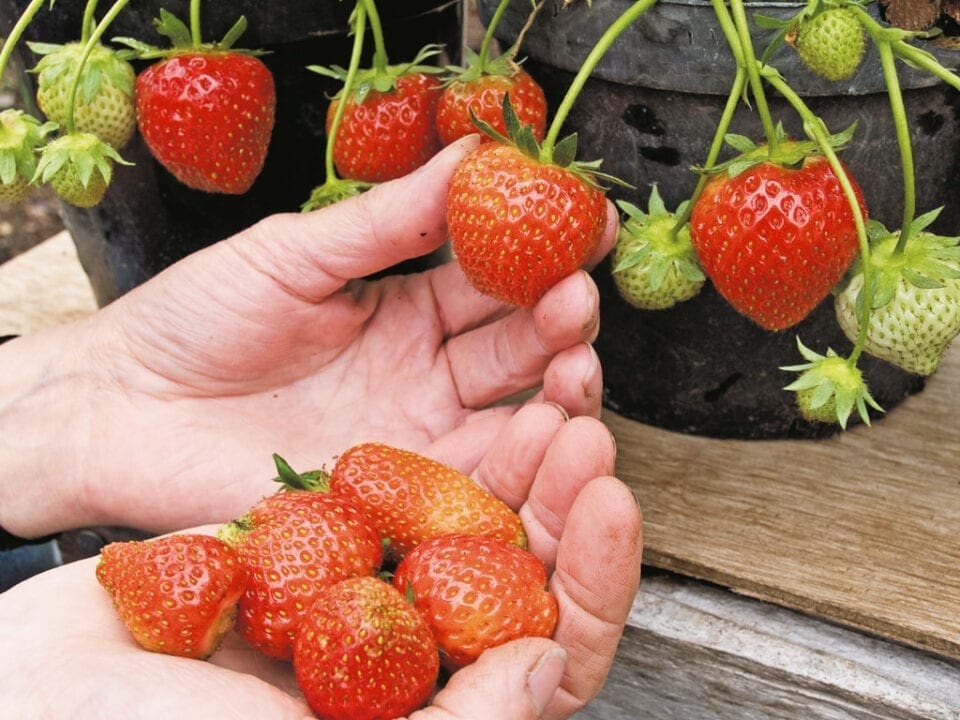
Strawberries are among the easiest and most adaptable fruits we can grow since they are just as happy in a strawberry pot on the patio or a hanging basket as they are in the soil on the veg plot.
Yet they are expensive in the shops and once you have tasted a homegrown strawberry you will never want to buy supermarket punnets again – the difference is truly amazing.
Choose the right varieties and you can plant from March onwards to be picking from June to mid- October and because they can be grown in pots as well as in the soil, everyone has room for a few plants.
Enjoy more Kitchen Garden Magazine reading.
Click here to subscribe & save.
For more growing tips and guides, you should subscribe to Kitchen Garden – you’ll receive free seeds with every single issue too!
Growing Your Own Strawberries – The Basics:
- Seeds or runners? Either is an option, but most gardeners choose to purchase established young plants called runners which can be planted out
- Timings: Plant runners from March onwards to be picking from June to mid-October
- Location: A sunny, well-drained spot. Grow in soil, pots, or even hanging baskets
- Planting: Bury runners up to the crown (where the root meets leaves) about 40cm apart
- Watering: Keep soil consistently damp
Choosing the right strawberry variety
There are lots of summer and perpetual strawberries available and it is a good idea to check the catalogues supplied by fruit specialists before buying. They fall into three main types:
- Summer fruiting
Early fruiting varieties crop from mid- June to early July, mid-season varieties a week later. Late fruiting types begin to crop in July. - Perpetual varieties
These produce a small amount of fruit in summer with the bulk from mid-August to mid-October. - Alpine strawberries
Grown from seed alpines are sold by most seed companies. The plants are decorative and ideal for pots or as a Planting time productive edging for the flower border.
Growing from seeds or runners?
Strawberries can be grown easily and cheaply from seeds and these will produce plants very quickly when sown in the spring to give a small crop in their first year. However, it is more usual to buy strawberries as ready-grown plants called runners.
When buying strawberry plants it is important to get them from a reliable source since a good grower will only obtain plants from virus-free stock, and it is well worth paying a little extra for these as they will fruit better and for longer.
When should I start growing strawberries?
Plants bought as cold-stored runners can be planted virtually all year round, but certainly from March until the autumn.
When planted in spring they should fruit in summer. For some varieties, in as little as 60 days.
You can get earlier pickings by forcing your strawberries – in March or early spring bring your strawberries inside or cover with a cloche to give them more warmth. However, it is important that strawberries are not brought inside over winter as they need a period of cold.
How to start growing strawberries
Although you can buy plants in pots it is quite common for mail order runners to arrive as bare rooted plants. On receipt, place the roots in a small bucket of water for a few hours before planting. You will notice a chunky crown just below the canopy of leaves – the water levels should be up to the base of this crown.
Choosing a growing site: The great thing about strawberries is they are very adaptable, and will happily grow in a pot or hanging basket as well as in the soil on the veg plot.
If planting in the garden, make sure that your strawberries are in an area that gets a lot of sun in the summer, ideally six to eight hours of direct sunlight a day (however Alpine strawberries can cope better with shade).
As well as choosing an area which receives a lot of sunlight, you should plant your strawberries in an area which does not become waterlogged in winter.
Strawberries will grow best when planted into previously dug soil which has had some well-rotted organic matter such as manure or garden compost incorporated, preferably the previous year.
Remove any weeds before planting. As a safeguard, you could plant your strawberries through a mulch of polythene or ground-cover fabric to prevent weeds from building up.
Plant to the base of the crown, not burying the very tip. Plant in rows about 40cm apart.
Harvesting strawberries
Once a fruit is fully red, pick and enjoy!
Pick regularly so overripe fruit doesn’t attract pests.
How to keep your strawberries coming back every year
In the garden, strawberries could come back for three or four years before the plants need replacing.
Each year, feed your plants in spring with sulphate of potash at the rate of 15g per sq m (1⁄2oz per sq yd) to give them a boost in preparation for fruiting. Avoid nitrogen feeds as these encourage lots of leafy growth at the expense of berries.
During the winter remove all the old growth before plants begin to send up new leaves and remove runners, which tend to sap the plants’ energy.
In winter, it is important that you do not bring the plants inside as they need a period of cold.
If your plants are young and healthy with no signs of virus, some of the best rooted runners can be planted in pots or in rows on the plot to make new plants for fruiting next year.
How to propagate strawberries – easily!
Did you know that after you’ve bought one strawberry plant, you basically have an endless supply?
All you need to do is propagate your strawberries. Take a runner from your strawberry plant, pin it into a new pot and water it in, not yet removing the runner from the main strawberry plant. Give your new plant a few weeks to root, and then you then simply cut the runner off from the parent – and there you have a brand new strawberry plant!
Scrumptious recipes for your homegrown strawberries:
More on strawberries
More grow guides
For more growing tips and guides, you should subscribe to Kitchen Garden – you’ll receive free seeds with every single issue too!