Martin Fish helps to demystify the seemingly complicated world of fertilisers.
What are garden fertilisers and what do they do?
Just like us humans, plants also need nourishment to maintain healthy growth. We do this by feeding with fertiliser, which is a concentrated source of plant nutrients. When it comes to what fertiliser to use, there’s plenty to choose from and it’s important you supply the correct type of fertiliser at the right time. For example, nitrogen is essential to promote healthy, green leaf and shoot growth, phosphorus (phosphate) encourages new root growth and potassium (potash) is for flowers and fruit and also plays an important role in plant metabolism. These three nutrients along with calcium, magnesium and sulphur, are important for healthy growth and are known as major or macro-nutrients.
Plants also need many other elements, and these are known as trace elements or minor nutrients. These include iron, manganese, boron, molybdenum, copper, zinc, and although only required in very small quantities, they are essential for healthy growth and if missing in the soil or compost the plant may develop deficiencies.
Enjoy more Kitchen Garden Magazine reading.
Click here to subscribe & save.
The majority of nutrients are already present in the soil, but over time these will be depleted by plants, especially in productive vegetable gardens, so extra feeding is usually needed. If growing in containers of compost, nutrients are quickly used up and feeding through the growing season will ensure strong plants.
What is in garden fertilisers?
By law, fertiliser containers have to display the nutrient analysis of the contents. The minimum requirement is the three main nutrients, nitrogen (N): phosphorus (P) : potassium (K). Other nutrients and trace elements may also be shown, but it is N, P and K that are the main ones we as gardeners want to know. The numbers shown represent the percentage of the nutrient in the bag. You will notice that there may also be another lower number at the side in brackets and this shows the part of the nutrient that is soluble. It’s a little more technical than that but essentially the nutrient analysis is a quick guide to show if the fertiliser is high nitrogen, high potash etc.

What type of fertiliser is best for my garden?
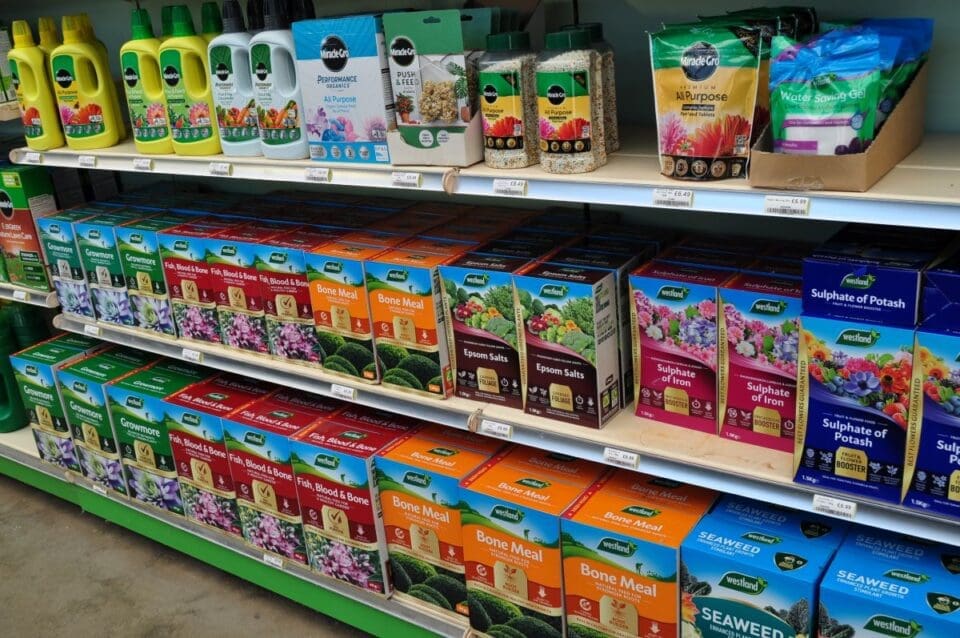
When you go to a garden centre to buy some fertiliser it can be a little confusing, especially if there is a large choice. We’ve got organic, inorganic, straights, compound, balanced, controlled release, fast-acting, slow release, liquid feeds and stimulants! On top of that there are also many specialist fertilisers for everything from lettuce to tomatoes. If you bought them all, you’d need a new shed to store them in.
If you are growing a range of plants, you may need a few different types, but very often one fertiliser can be used on a wide range of plants in the veg plot and flower garden to help keep things simple!
- Organic fertilisers are natural and are derived from living organisms such as plants or animals. Dried blood, poultry pellets, seaweed, fish, blood & bone just a few examples. Some are longer lasting in the soil because they break down slowly.
- Inorganic or artificial fertilisers are man-made or mined minerals. They can be a mixture of nutrients such as Growmore 7N:7P:7K or a single nutrient such as sulphate of ammonia 21%N. They tend to be more concentrated and faster acting.
- Straight fertilisers supply just one nutrient and tend to be used when you want to give plants a boost of nitrogen, phosphorus or potassium. They can be organic such as dried blood 13%N or inorganic such as sulphate of potash 48%K
- A compound fertiliser is a mixture of several different nutrients mixed together to give a general feed. All contain major nutrients and some also have trace elements. Examples of a compound fertilisers are Vitax Q4 and dried chicken manure.
- Balanced fertiliser contains the main major nutrients of NPK in equal amounts. They are used as a general feed to encourage overall growth on the plant. Probably the best-known balanced fertiliser is Growmore, which has been around since the 1940’s.
- Slow-release fertilisers basically released their nutrients gradually over a longer period of time. Some artificial types can be made to break down slowly and others such as organic Bonemeal naturally take a long time to release their nutrients.
- Controlled release fertiliser was originally made for the nursery trade around 50+ years ago. The resin coated fertiliser granules expand in warm weather to release nutrients and close down when it’s cold and plants aren’t actively growing.
- Liquid feeds are essential fertiliser in a concentrated form that is diluted with water to create the correct strength of feed for the plants. They are fast acting as the nutrients are immediately available to the plants to drink in.
- Soluble fertilisers are fast acting when watered around plants. They are in powered form and many contains all the major and trace elements. You simply dissolve the correct amount of dry fertiliser to an amount of water and apply