Want to grow fruit in pots on your patio or in your backyard? Kitchen Garden Magazine’s fruit expert David Patch shares his advice on how to grow apples, pears, blueberries & more in containers.
David says:
You can pretty much grow any fruit you like in a container – so if you have a hankering to grow a peach or even a pineapple, don’t let so-called experts like me try and put you off. The only limit is your imagination and, crucially, the amount of time and effort you will have to devote to your prized specimen. Some fruit is undoubtedly much easier to grow in a container than others, so be realistic at the outset about the amount of care and attention you are willing to give.
Enjoy more Kitchen Garden Magazine reading.
Click here to subscribe & save.
Some plants will need watering twice a day in the summer months, fleecing when frost is due, and a careful eye given to feeding in order to get good crops. Others will fare quite well on a much less intense regime, so choose wisely and you are more than halfway to your goal.
Before we go on to consider some specific fruit that should be towards the top of anyone’s list of patio fruit, there are some general rules which apply to just about all container-grown plants.
The easiest plants to look after will be those that fruit on permanent branches. Once you have this framework established, there will be a lot less effort involved in feeding, watering and pruning. Contrast this with plants that mainly fruit on new growth (raspberries, blackcurrants, blackberries, rhubarb and all the stone fruit), where you have to provide enough water and feed all through the growing season to get not only a crop of fruit, but lots of new growth for subsequent crops.
With these plants, the demands on the plant (and consequently on you looking after it) are much higher – so unless you have lots of time and are happy to dote on the plants, they are probably best avoided.
Top fruits for growing in pots
APPLES AND PEARS
These are probably the easiest top fruit to grow in a container. They fruit on spurs on old wood, so once you have some branch framework established, they will carry on fruiting on the same branches for 10 years or more. All the stone fruit, on the other hand, tend to fruit best on one- or two-year-old wood, so you will be continually trying to strike a balance between pruning to promote new fruiting wood and leaving some growth on for immediate crops. Add in the higher susceptibility to bacterial canker that can be an issue for plums, gages and cherries, and they definitely become some of the trickier, but not impossible, patio fruit.
One of the most common mistakes we see at the nursery is the belief that a dwarfing rootstock is needed for growing a tree in a pot or container. Growing in this way severely restricts the root development, and thus the vigour of the tree. There is a real danger that a tree on a dwarfing rootstock in a pot will end up as poor unproductive specimen – go one size up in terms of rootstock and let the pot (and your secateurs) keep growth under control and you’ll have a healthy tree that produces plenty of fruit.
BLUEBERRIES
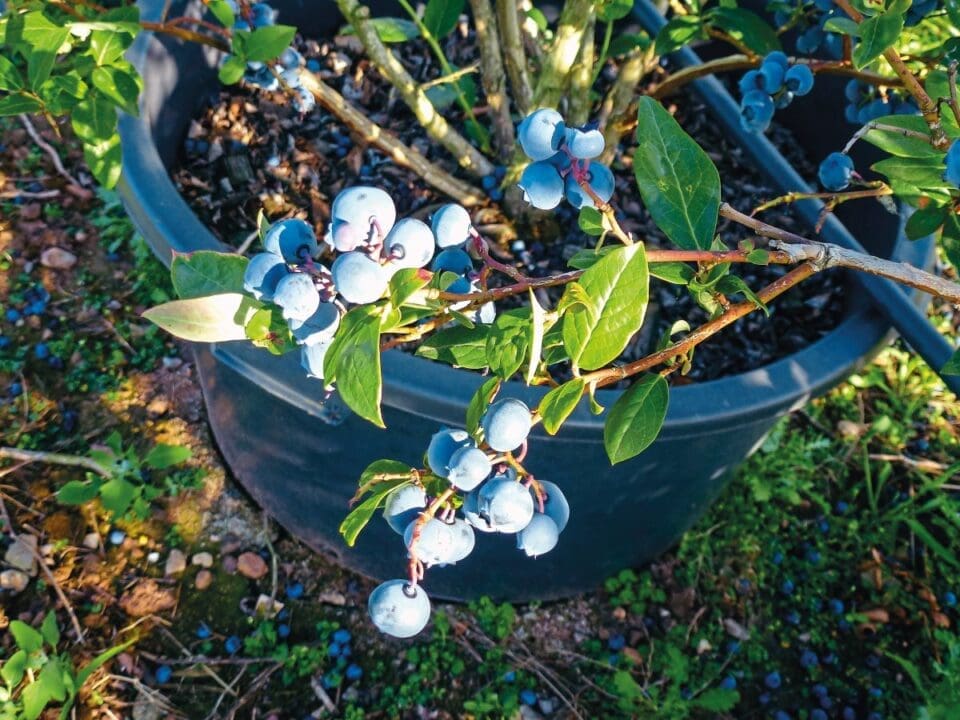
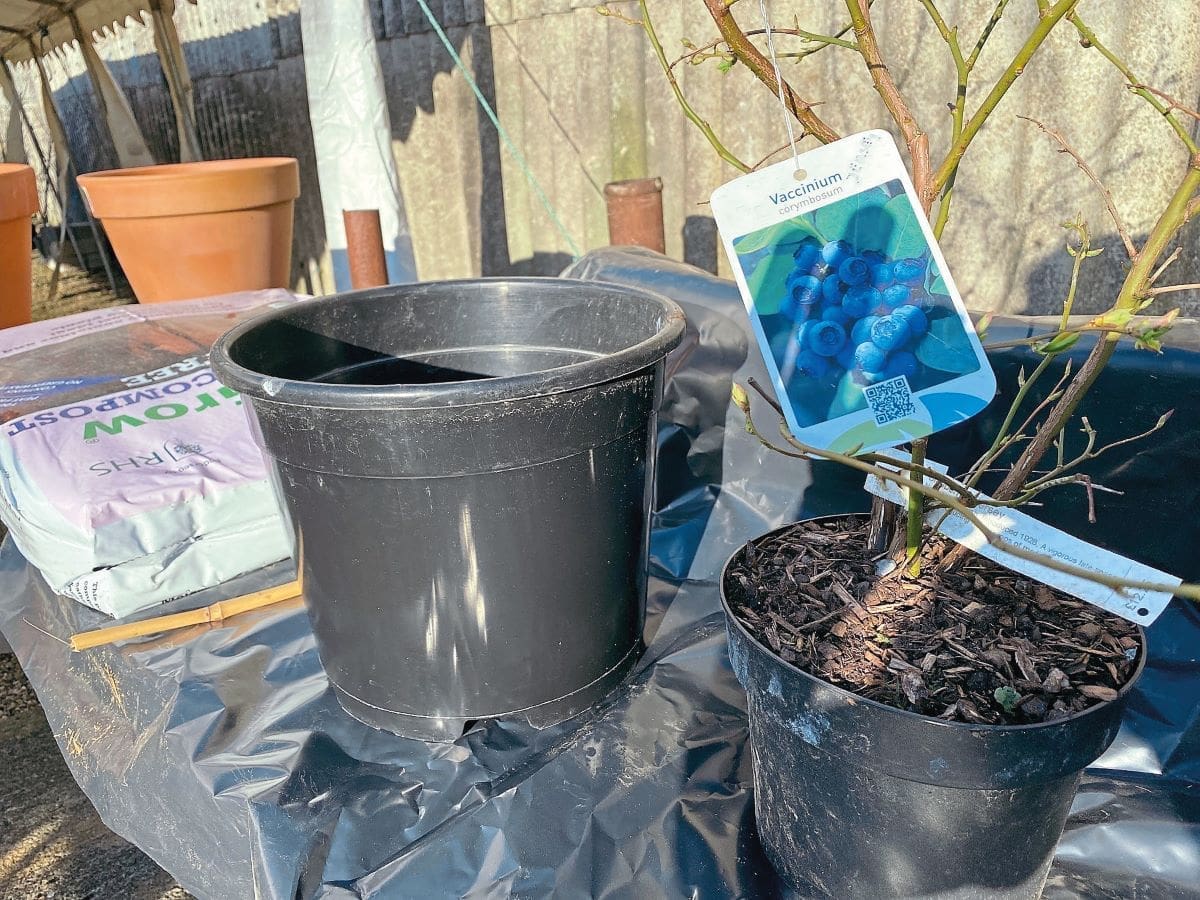
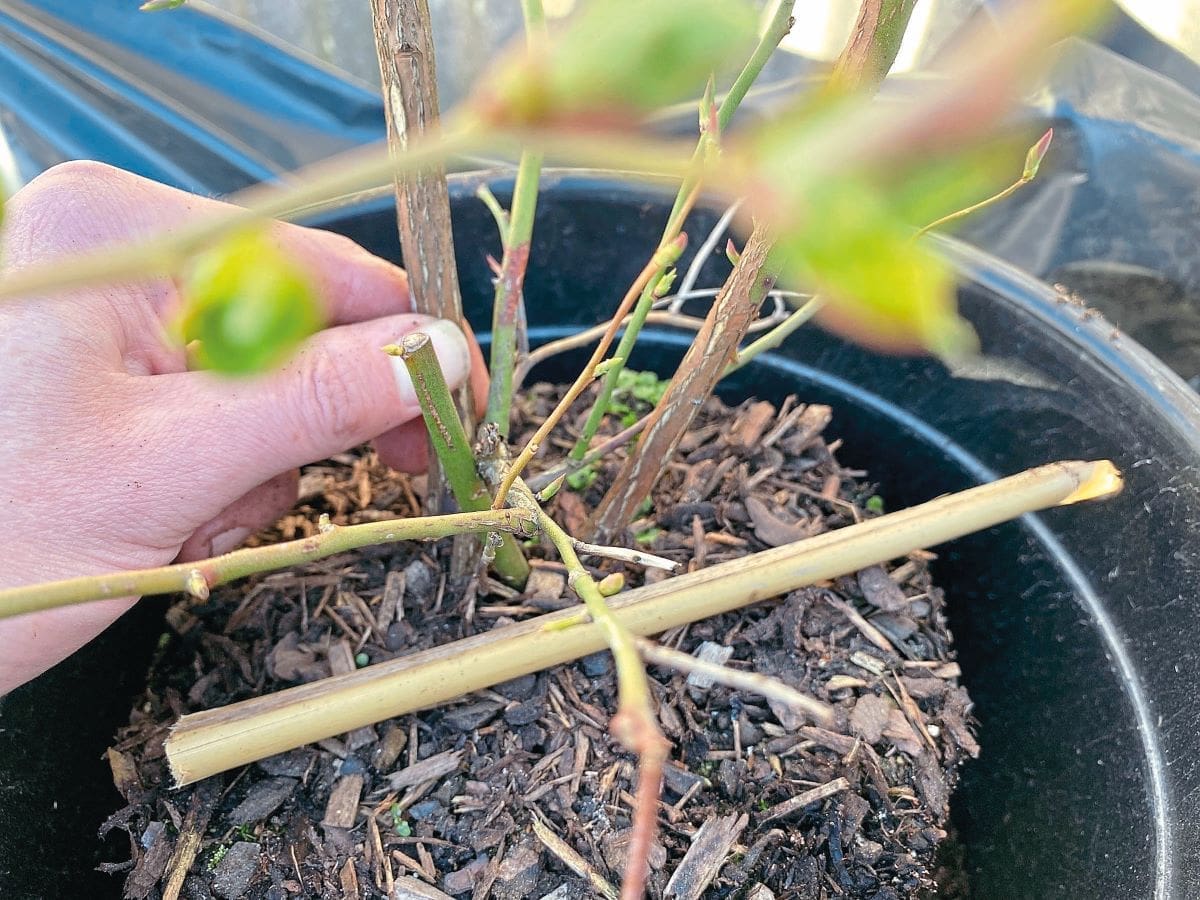
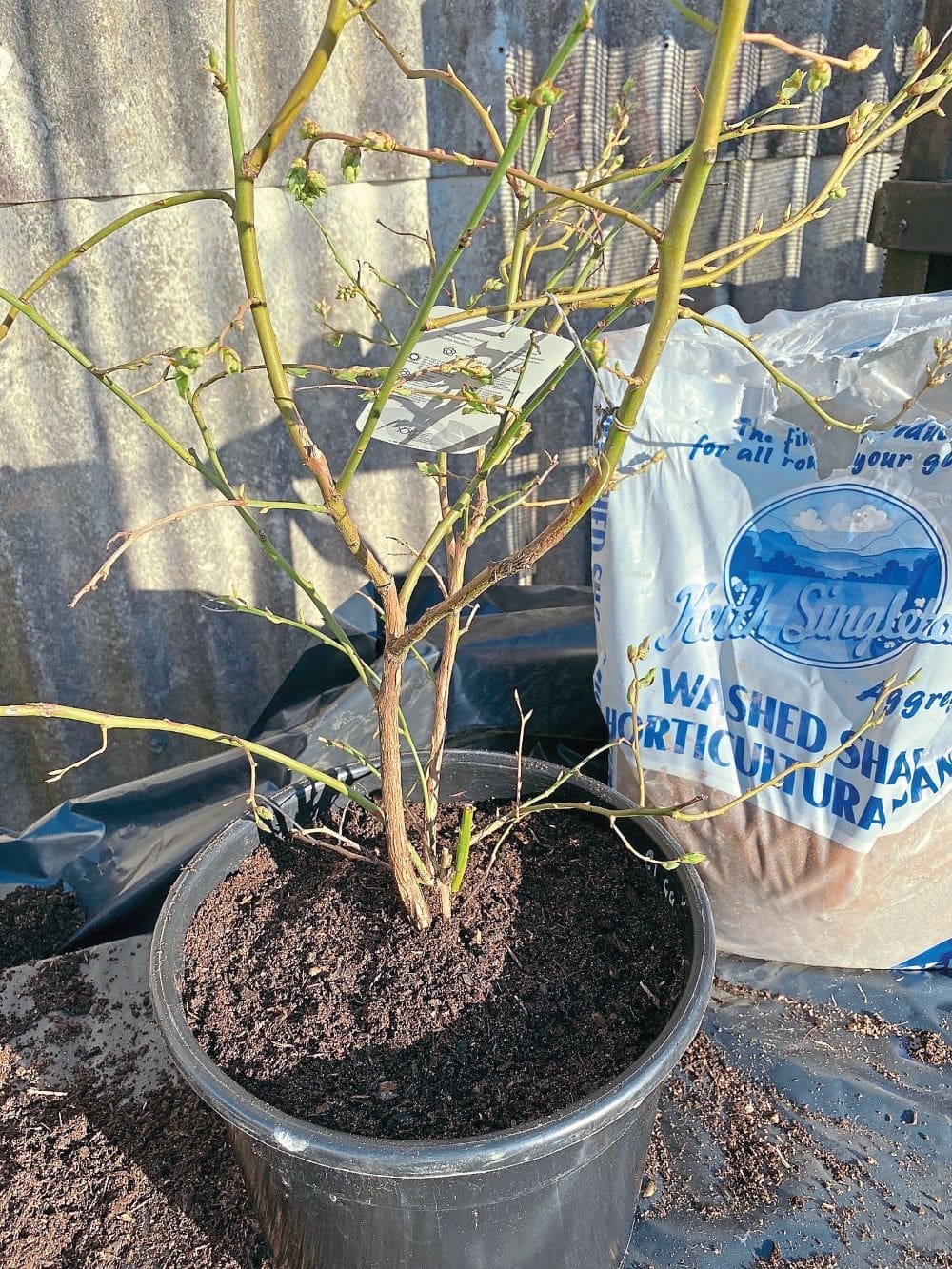
Blueberries need an acid soil to grow well. The ideal pH is between 4.3 and 4.8, so it is unlikely that your own soil or a general multipurpose compost will work. Instead, look for ericaceous compost – most garden centres will stock it – which is specifically formulated for all acid-loving plants such as blueberries, azaleas and rhododendrons. Blueberries also like a well-drained, well-aerated soil, so it is a good idea to mix in a little washed sand (it is washed to remove the lime that normal or ‘builders’ sand contains) or composted bark. I tend to use a mix of 60% ericaceous compost, 30% bark and 10% sand.
Blueberries need soft water, so you should always use rainwater if at all possible. If we have a dry summer and your water butt has run dry, by all means use tap water in an emergency, but revert to rainwater as soon as possible.
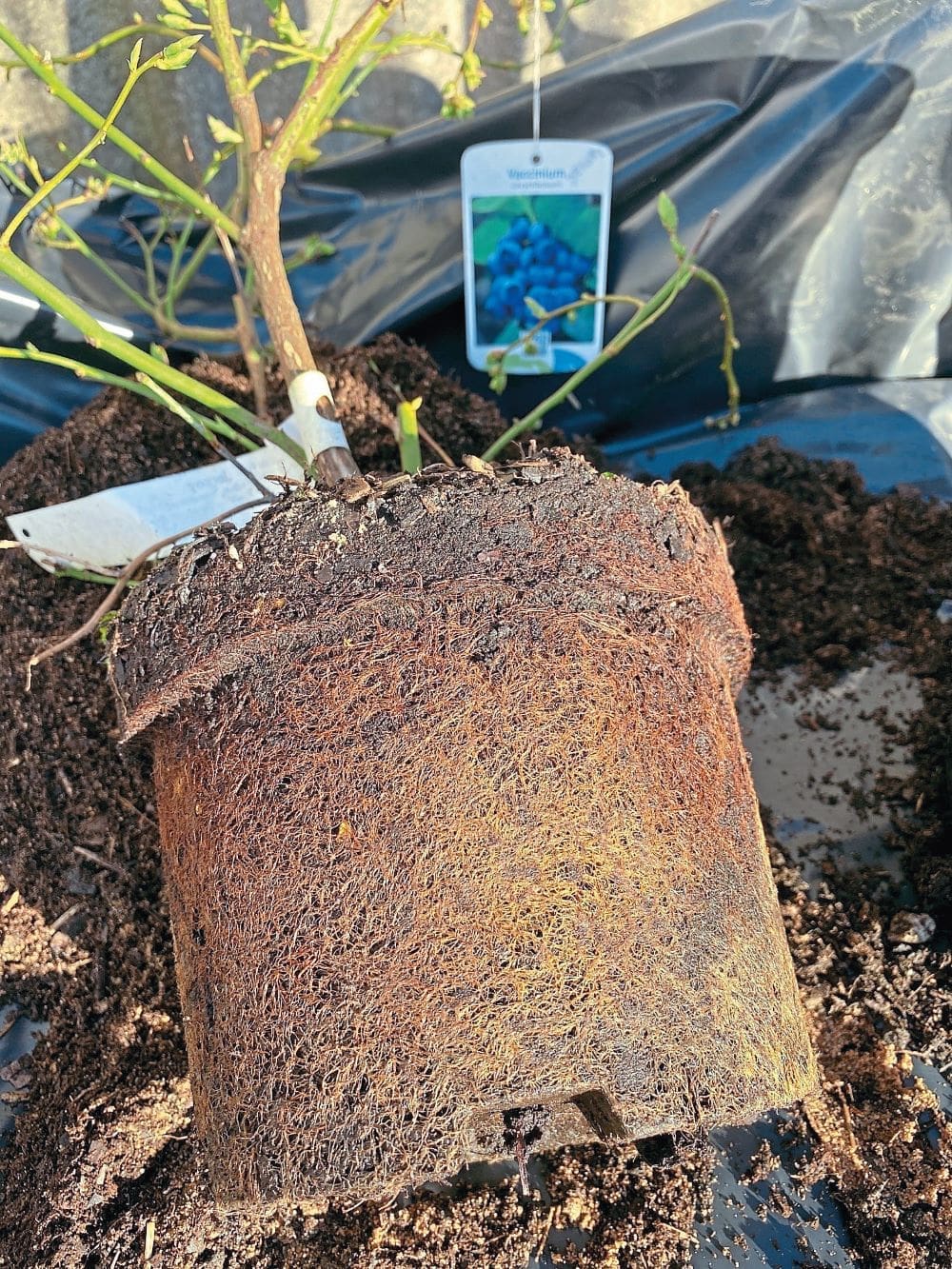
As plants get older and bigger, it is a good idea to pot up into a larger container every year or two. Blueberries quickly develop a dense, fibrous root system and ideally you want to move them to a larger pot before they get too root bound. The bigger volume of compost will help keep moisture levels even, which means the fruit should swell nicely. While blueberries can survive in dry conditions over the summer, the fruit will tend to stay smaller, the skins will be thicker and they won’t be as sweet.
FIGS
Figs make fantastic potted trees for a sunny patio, where the lush foliage is attractive in its own right. Use a soil-based compost such as John Innes No 3, and make sure you put plenty of crocks at the bottom. Most figs are hardy enough, but they will resent spending the winter months with waterlogged roots.
If you are growing in a container, feed with a high-potash fertiliser (such as tomato feed) over the summer months, and keep the compost just moist. While figs tolerate dry conditions, they will shed their fruit if they get too dry.
Figs will naturally try and crop twice every year – one crop which develops and ripens over the summer to crop in early autumn, and another which overwinters and ripens over spring and early summer. In the UK our winters are too cold and long for this second crop to ever develop, and trying to do so only weakens the plant. In October it’s very important to remove all fruits which are larger than your little fingernail. Don’t be greedy, this fruit will never ripen and they will stop the following year’s summer crop from developing properly.
STRAWBERRIES
Strawberries love a free-draining soil, ideally in full sun. They do need some moisture to allowthe fruit to develop properly and not split. Good quality multipurpose compost is fine, but I like to add about 25% of a loam-based compost such as John Innes No2.
When you buy runners in winter, the foliage may well look a little worse for wear – remove any damaged or dead foliage. It doesn’t matter how dishevelled the leaves may look, but you do want the growing point of the plant to be nice and firm. Plant with the growing point just level with the soil surface and water once to get the soil to settle around the roots. Place in a sunny, slightly sheltered position and keep an eye on the watering. Remember it is far better to under-water rather than over-water at this stage, as they are only making root growth, but increase watering slightly as soon as new foliage starts to emerge.
High levels of sunshine in May and June as the fruit are developing dramatically increase the sweetness levels, so even though strawberries will tolerate semi-shade, plant in full sun to get the best quality fruit. Regular feeding with a high potash fertiliser from April onwards will also help. A liquid tomato feed is ideal but remember to water the soil and not the plants – keeping the foliage dry helps ward off powdery mildew and other fungal diseases.
Frequently asked questions about growing fruit in pots
What pot to choose when growing any fruit in containers
It’s always worth remembering that the larger the volume of compost, the easier it is to look after the plant. Plants in small pots dry out much quicker than those in larger ones, so always try to end up with as large a container as possible. A half barrel is normally a good size to aim for if trying to grow a top fruit tree such as an apple or a pear, while 10-12 litres will suffice for most soft fruit.
It’s a very good idea to pot up into a slightly bigger pot immediately after purchase, that way you can make sure the plant isn’t pot bound, which will inhibit its growth and cropping potential. While it is tempting to immediately use a much larger pot, it is actually best practice to go up in size gradually over the course of a few years. Putting them straight into a much larger pot will leave much of the soil unused and increase the risk of it becoming stagnant.
The choice of material for the pot – terracotta, plastic, or even old metal tins and troughs – will be largely a matter of aesthetics and personal choice. However, be aware that terracotta and clay pots do dry out a little faster as they are porous, and light-coloured metal containers can quickly heat up in the summer. Black plastic might be the boring option, but it is certainly the most practical.
How to ensure good drainage when growing any fruit in pots
This is crucial, whichever pot or container you choose. Nothing will enjoy spending the winter sitting with waterlogged roots. Use plenty of crocks in the bottom of the pot to stop drainage holes becoming blocked (some larger plastic pots actually have drainage holes on the side as well as the bottom – it’s well worth looking out for them).
It’s also a very good idea to use pot feet or half bricks to raise the pot, especially over winter. If placed on a hard surface such as brick or stone patio, you can find that water forms a ‘seal’ around the base of the pot and stops water escaping (a little like putting a wet teacup upside down on a flat surface). Lift the pot off the ground and excess water can escape.
How much to water when growing fruit
Constant, even moisture levels are the holy grail here. Too much variation in moisture can cause the fruit to split, or stay small with tough skins, so aim for an even level as much as you can. Check pots daily, and water at the same time every day (ideally, early morning or evening, avoiding the hottest part of the day). Automatic irrigation systems (or a friendly neighbour) are a real godsend in this respect.
What feeds to use when growing fruit
Regular readers will probably know by now that most fruit grown in the ground really only needs some extra potash through the spring and summer to encourage good crops. Growing in a container is different – although good quality compost will have a balanced feed included in it, this will quickly get used up by the plant. Nutrients also leach out of the compost through regular watering, so a good feeding regime is essential for all patio and container-grown fruit.
In March apply 30g (1oz) of a slow release balanced plant food, such as blood, fish and bone, Growmore or Vitax Q4 – this will have some nitrogen in it, for new growth and healthy foliage, and some potassium for root development. Then switch to a liquid tomato feed over the summer months for the best quality fruit. Little and often is the key here – plant food is getting quite expensive these days, so you don’t want to waste it by seeing it run out of the pot and on to the patio!